Harry Potter musings

I’m rereading the Harry Potter books–I just finished Prisoner of Azkaban last night. This is the first time I’ve read all the books straight through, from 1 to 7. I’m really enjoying noticing all the details that continue from book to book, and the foreshadowing I never saw before.

I also recently started playing Pottermore, an online Harry Potter game that allows you to unlock new information about the wizarding world. There are also achievements and Houses and points and whatnot, but I don’t really care about those, especially since I was sorted into Slytherin.

As I’ve discussed my dismay over my sorting with friends, it’s grown abundantly clear that I am the only one who finds this bothersome. I’m hoping as I reread the books that I will come to a new understanding of Slytherin, at least enough so that I can understand why Pottermore would sort people into it rather than leaving it as the antagonist group it was in the books.

Friends tell me not to look at it in black and white, that of course the books are prejudiced against Slytherin because they’re written from Harry’s perspective. I can understand this argument, but I’m not sure the text backs it up. Ideally, if Slytherin had good people in it, we would see them. All the Slytherins I can recall seeing in the books turned out to be jerks, if not entirely evil. While you can argue that we simply didn’t see the good Slytherins, I would counter that this omission is a flaw. If there are good Slytherins, we should see them. At least a few examples. Something to demonstrate that the world isn’t black and white. But all I remember from my first and second readings of the later books is that all the Slytherins turned out to have Death Eater parents. Everyone who was remotely antagonistic in the books–even the executioner from the Department of Magical Creatures, who really should have been anonymous and unbiased–seemed to be a Death Eater. So sure, you can argue that being a Slytherin doesn’t automatically make you a Death Eater, but it dramatically increases the chances. And meanwhile we never see, that I recall, a Death Eater who is from a house other than Slytherin.

I am paying close attention to the Houses this time around, hoping to find some evidence to counter my prevailing impression. For example, I never saw any mention of which House Peter Pettigrew belonged to. It seems logical for him to have been in Gryffindor (thus making “all evil comes from Slytherin” false and also making “all Gryffindors are brave” false [Edit: I've just started Goblet of Fire, and you could argue that briefly standing up to Voldemort on Harry's behalf is brave...maybe]), but as far as I’ve seen, there is no evidence of which House he was in. Pottermore may have this information; this essay seems to indicate so. It also states that Quirrell was a Ravenclaw, which I don’t remember from the book, but that’s also counter evidence if true.

But if all the information that would redeem Slytherin comes from sources other than the actual books, I will be disappointed. I would hope, that as the years pass and Harry grows up, he would start to recognize gray areas. Surely our hero isn’t so myopic that he would never see a good Slytherin or a bad member of another House, if those allegiances actually exist.

So yes, I’m keeping my eyes open as I reread. If I come across any good information from the original source material–the books themselves–I’ll update this post.

In the meantime, I’ve pretty much decided not to play Pottermore anymore.

Edit 03/03: I am now into Order of the Phoenix. This book, along with Dumbledore’s speech at the end of Goblet of Fire, contains the first broad-spectrum view of the wizarding world, exhortations for the four Houses to unite. Harry is of course still anti-Slytherin and can’t imagine working with them. In Half-Blood Prince will come the examples of “good” Slytherins Snape and Slughorn (or at least, Slytherins with whom people from other Houses can work). I’ve already mentioned my problems with Snape and Slughorn; I’ll keep my eyes open for other Slytherin examples. It would be nice if my memory is wrong or incomplete and there is more to this than simply “work with whoever you can get, even the lesser of two evils, even if you have to spend copious amounts of time keeping them on track.”

The Ballad of Narayama

The Ballad of NarayamaLast night I watched the 1958 Criterion Collection film The Ballad of Narayama on Hulu. This film deals with the possibly mythical tradition of ubasute, literally “discarding the elderly”. While Hulu’s plot summary made it seem as though the film is about a man struggling with having to leave his mother in the mountains to die, much of the story comes from his mother’s perspective. I would characterize this film more as the contrasting reactions of a very close mother and son to a tradition that forces them apart. (Criterion’s plot summary is much better.)

Where mother Orin is profoundly interested in tradition and saving face, son Tatsuhei is more strongly affected by the now, by the people and things he personally cares about. This contrast is plainly evident from the very beginning of the film; Orin is excited to have found a new wife for Tatsuhei, someone who can take care of her son once she’s gone to Mt. Narayama to die. Meanwhile, Tatsuhei is still mourning the loss of his first wife, and the thought of a new one simply causes him to worry about food supplies and remind him that he will lose his mother soon.

Tatsuhei’s son Kesakichi, a worthless layabout who has gotten his girlfriend pregnant, is often a catalyst for dissent in the family. He objects to getting a “new mother”, wanting to maximize available supplies for his girlfriend. He incites the local children to sing songs about demons with 33 teeth, which shames Orin, who at 69 still has 28 teeth. She is so unhappy that people and gods might think she is prideful or that she won’t accept her death at 70 with grace that she smashes her mouth into a cooking pot to break and knock out her own teeth. Tatsuhei is horrified; sobbing, he insists that Orin eat the special treat of white rice she has made for the festival, frustrated at the idea that she might no longer be able to enjoy food.

As Orin continues to put her affairs in order, Kesakichi continues to be obnoxious, bringing his girlfriend to live with the family and giving her most of the food, asking Orin when she’ll be going to Narayama. His girlfriend becomes bold too, joining in on these torments, but Orin accepts it all calmly, repeating that she’ll be going to Narayama at the New Year, the year she turns 70. Tatsuhei can say nothing to dissuade her and hides his face under a towel to cry.

Orin and Tatsuhei’s new wife Tama bond immediately, and their relationship is one of the best parts of the movie. Tama loves Orin as a mother and mourns almost as openly as Tatsuhei at the thought of her impending sacrifice. Unlike Tatsuhei, however, aside from one comment at their first meeting, Tama says nothing to Orin about her choice. She makes no attempts, subtle or otherwise, to change Orin’s mind. Perhaps she respects Orin’s independence over her own selfish desires. Or perhaps she recognizes the futility of fighting tradition and simply doesn’t want to make the event even harder on the family.

Neighbor Mata is already 70 and has resisted going to Narayama. He is starved at home and comes to Orin for food. Mata serves as an example of the cost of fighting tradition. In the end he is bound, dragged into the mountains, and flung off a cliff by his son.

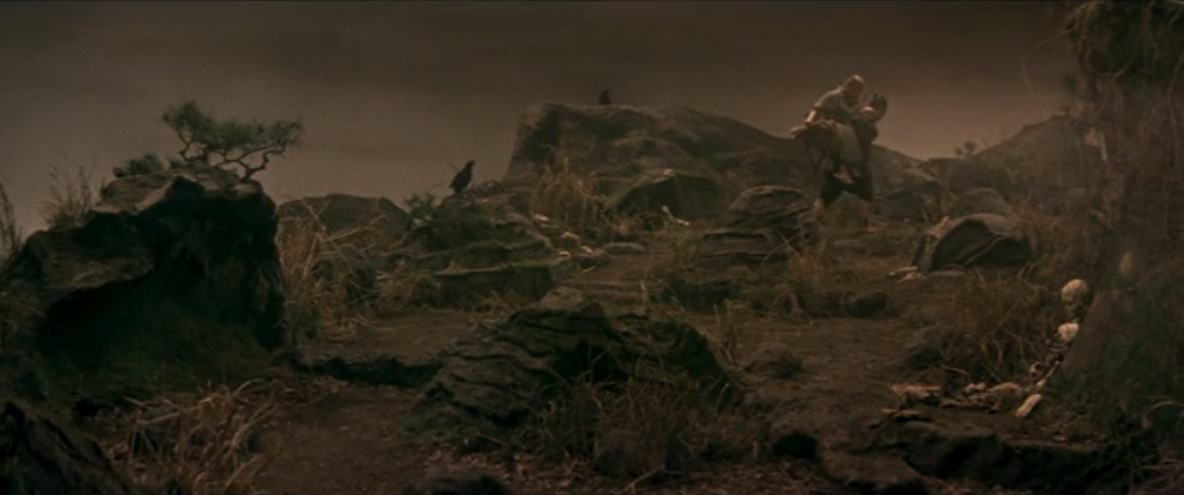
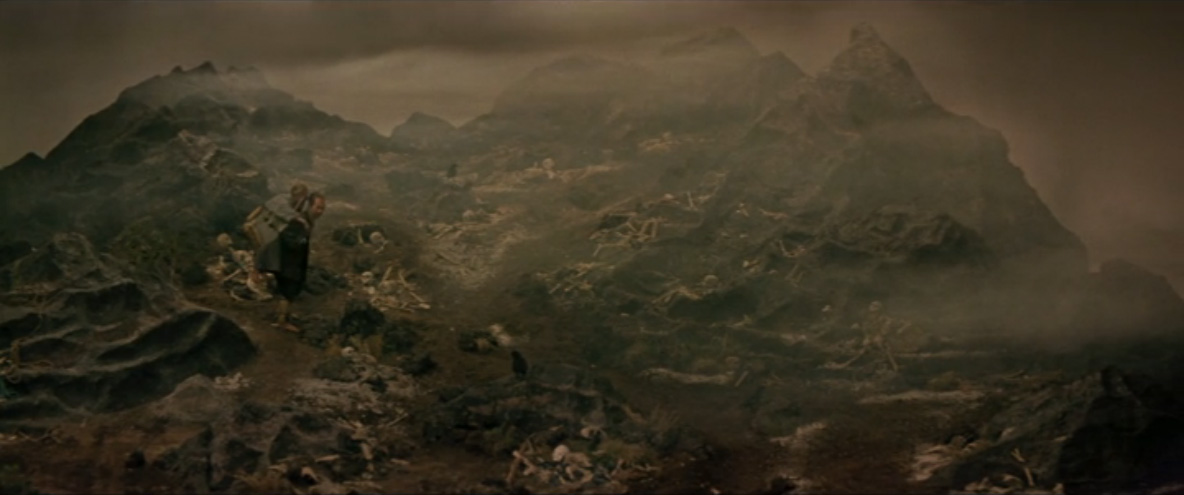
And in the end, Orin’s wish to follow tradition is honored by her son, who carries her into the mountains on his back. Following established ritual, they are not allowed to speak once they enter the Narayama area, and so Tatsuhei stumbles unwillingly, silently through forest and rock and then piles and piles of skeletons as crows look on.

The sets in the film are fascinating; obviously the backgrounds are paintings, and transitions are done by cutting the lights and moving large props to reveal new scenes such that it feels like watching a play. But the sets are sprawling and elaborate, larger than any theater could contain. The camera pans along them, following actors as they move down paths and into detailed structures. The Narayama skeleton set is eerie; I honestly didn’t expect it, and I stared speechless at the clusters of bones surrounding Orin and Tatsuhei.

boneyard entrance

Tatsuhei and Orin in the boneyard

The final scene, showing a train pulling out of a station called Obasute, looked too real by comparison to all the other sets; it was jarring. I’m not sure what the point of that scene was, other than perhaps to make the point of the movie obvious. In my opinion it already was, so the scene is unnecessary.

I’m unclear on whether or not ubasute ever actually occurred. From the movie, I can understand why it might have–food supplies being low could inspire communities to dispose of their least productive members. Indeed, the film includes a different example of such a thing happening; an entire family is killed after it’s discovered they have been stealing. In this sense, I find the contrast between Orin and Kesakichi fascinating; of the two of them, Orin is far more useful to the family. (Orin knows how to catch trout, and shares her secret only with Tama; she admonishes the other woman not to tell anyone, perhaps highlighting the need for someone in this community to be of use. If only Tama knows the secret, her value goes up.)

What value does Kesakichi bring? He adds a mouth, eventually two mouths, to feed and doesn’t do his share of the work. If there was a “just” system for rooting out those who didn’t contribute, Kesakichi would be the first one kicked to the curb. But of course, getting rid of the young isn’t the tradition.

And despite the way he treats her, Orin loves Kesakichi and takes care of him and his girlfriend just as well as she takes care of the rest of the family. She is willing to sacrifice herself for the sake of tradition, but I wonder how she’d feel about others? After all, while she chides Mata for not going to Narayama, she still feeds him. Somehow, I can’t see her doing to Kesakichi what Kesakichi did to her.

Then again, even if she did, Kesakichi wouldn’t care. He’s not interested in tradition or saving face; he’s just interested in himself.

I’m sure this contrast between Orin and Kesakichi was intentional, meant to underline the importance of valuing our elders instead of tossing them aside. And I have to say it was effective, because I love Orin and I hate Kesakichi.

I found myself relating to and sympathizing with Orin. Her need to be accepted, to fit the mold others had created for her, was tragic, and cost her her life while she was still perfectly healthy. But she took it all with a smile, with no complaints. This made the message of the film far stronger than had she rebelled against her fate. We saw the lengths she was willing to go to stay in people’s favor; we understood the sheer ridiculousness of it; yet we knew she really had no choice, and that made her devotion to her reputation come off as brave rather than pathetic.

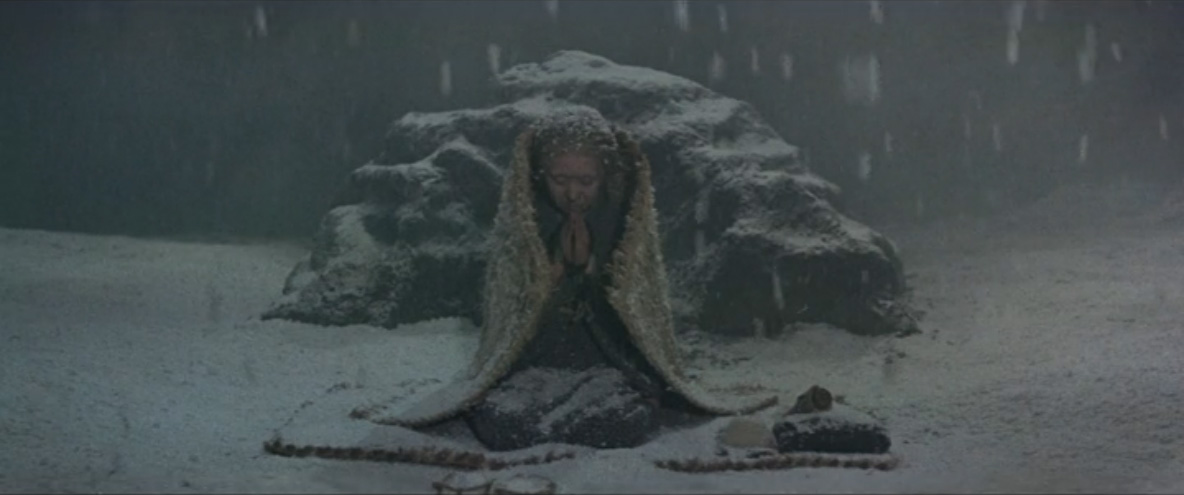
Orin in the snow

Orin waits in the snow to die. The Ballad of Narayama, 1958

Sherlock deductions

Sean and I finally watched series two of Sherlock, finishing up last night, and I’m so excited about my Reichenbach deductions that I wanted to write them out. If you haven’t seen series two, stop reading now and go watch it on Netflix. Then come back.

Here are the things we know:

Sherlock chose the final meeting place with Moriarty.

Sherlock doesn’t fulfill Moriarty’s demand until John arrives. He tells John exactly where to stand and watch, and he also tells him some very specific things, saying it’s important.

When Sherlock jumps, he doesn’t go head-first. As smart as he is, he’d know that would be the best way to die. Instead, he jumps in such a way that he’d seemingly land on his hands and knees.

After the fall, the first thing that happens is John is clipped by someone on a bike. He’s disoriented. By the time he’s back on his feet, a crowd has clustered around the “body”. John runs over, but time has passed. And the crowd, while letting him get a look, ultimately doesn’t let him examine Sherlock.

We don’t see the funeral. We therefore don’t see if it was open casket.

We don’t see what happened to Moriarty. No one but Sherlock knew he’d “shot himself”.

More generally:

Sherlock Holmes, like James Moriarty, is an actor. He can pretend anything. He can even be friendly if he wants to; he just rarely wants to.

Sherlock and Moriarty have similar intellects and drive. They are both willing to go beyond what would normally be considered, well, sane. We know this from the end of series one, not just from the conversation and suicide one-upsmanship at the end of series two.

The information Moriarty has on Sherlock comes primarily from their interactions in series one and from Mycroft. This means he is estranged from new information, especially after Sherlock finds the hidden camera.

As Sherlock has never indicated any interest in Molly beyond using her as a tool, Moriarty has no reason to think she is important to him. Indeed, Sherlock confirms this when he asks, “Watson? Mrs. Hudson? Lestrade?” (Technically Molly may never have caught Sherlock’s notice if she hadn’t observed his mental state, but that’s tangential. The point is, up until then Sherlock never would have considered Molly a part of his “team”, and so Moriarty doesn’t either.)

I believe that at the point Sherlock told Molly he thought he was going to die, he had already deduced 1) how Moriarty had managed his break-ins; 2) how Moriarty planned for his taking-down of Sherlock to end–suicide in disgrace. He may have even deduced 3) how far Moriarty was willing to go to ensure Sherlock killed himself. And as he knew Moriarty would have plans in place to deal with Watson, Mrs. Hudson, and Lestrade, this knowledge didn’t help him come up with a way to outfox Moriarty, because if he enlisted their aid, Moriarty would know…hence Sherlock’s desperation, and his sudden epiphany that he could rely on Molly.

(I imagine the writers are making a point about the importance of human relationships here, a theme I think the Holmes-inspired House could have used a bit more of…but perhaps I’m reading in a bit too much ;)

And so Sherlock’s plan to save his friends and best Moriarty depended on two things: Moriarty not knowing he was relying on Molly, and Moriarty continuing to underestimate him. Sherlock had to act out his deductions as if he were having them for the first time on the rooftop, too late to do anything about them. But in reality, he’d already set a plan in motion through Molly that would allow him to jump from the rooftop, appear dead, but emerge unscathed. This plan had the crowd below, the guy on the bike, and even the medical team that picked up his body in on it–just as Moriarty had people at every level in on his break-in scheme.

Further, I don’t think Moriarty is really dead; he goes on and on about how hard it is to keep on living when everyone is so dull, but the sense of self-preservation isn’t that easy to kick if you’re not actually depressed…and Moriarty isn’t depressed. He’s bored. “Killing” himself probably seemed like a fun idea. Sherlock probably knew Moriarty wasn’t dead, as well, but he’d tried the verbal jousting route and the safest way to protect his friends was to go through with the fake suicide plan.

What I’m interested in seeing is where things go from here. I don’t quite remember from the stories, but I believe there was one in which Sherlock was said to have survived Reichenbach Falls after all. Maybe in the interminable time before series three I’ll go back and reread.

Otome Youkai Zakuro

Otome Youkai Zakuro

This week I watched the 13-episode series Otome Yokai Zakuro, or “Demon Girl Zakuro”, on Crunchyroll. It’s based on an ongoing manga series about a half-spirit girl named Zakuro, her half-spirit and full spirit friends, and the human imperial army officers who team up with them to form the Ministry of Spirit Affairs. The story takes place in 19th century Japan shortly after the Meiji Restoration, during a time of unrest and change due to westernization. In this slightly-altered history, humans and spirits live side-by-side, but westernization efforts are marginalizing the spirits, causing conflicts to arise. And of course, there are evil spirits, too. Zakuro’s team takes requests from various parties, then attempts to nail down the problems that are occurring and resolve them.

One thing I noticed right away was that the male lead, Agemaki Kei, was voiced by Sakurai Takahiro, who also voiced my beloved Shibuya Yuuri from Kyou Kara Maou. He plays a similar character here, so his voice is pretty much the same as Yuuri’s. It was really nice to hear it again. At the end of the series, he even has a very Yuuri-esque line about people coming to understand one another. ^^

I found the setting extremely interesting. While the spirits live in a traditional-style Japanese house, and many people on the street still wear traditional garb, there were also plenty of people wearing western-style clothes, and the army officers’ uniforms were of course western-style. The characters took trains, new to Japan, to reach distant clients. Much talk was made of the “new calendar”. (Japan adopted the Gregorian calendar in 1873.) Overall, there was kind of a Victorian-meets-traditional-Japan vibe.

I loved seeing Zakuro and her friends’ reactions to things like cookies and milk. While the others were generally cheerful and open-minded, Zakuro often complained about cultural items and practices she dubbed バテレン–bateren, a word referring to Portuguese Jesuits or simply to Christianity itself. (The Crunchyroll translator subtitled it as “Jesuit”.)

The artwork was quite pretty, and the animation was very smooth. The story didn’t shy away from some particularly nasty concepts, such as a spirit that liked to eat women and children. There was some stylized violence, but not fountains of gore.

Pacing was Zakuro‘s weak point. I didn’t realize going in how short the series was, and as various concepts were introduced I imagined it would take many episodes to resolve them all. The series climax seemed to come out of nowhere, and the resolution seemed to drag while still somehow feeling hasty. With all the threads the story had woven together, we needed more time with the Ministry of Spirit Affairs to see their bonds grow, more time seeing Onodaka leading from the shadows before it became obvious who he was, more time to spin out Zakuro’s story so it didn’t feel like we had to choke down an entire buffet line of exposition during the series climax.

I did like the denouement…even the two-second, blink-and-you’ll-miss-it car passing by to answer the question of what happened after the fire. It all left me with a good feeling. (Except Zakuro’s persistent tsundere tendencies. Honey, at some point you’ve got to just roll with it.)

I also liked the flashback scenes with Zakuro’s mother, in no small part because they featured Morikawa Toshiyuki, who played Conrad in Kyou Kara Maou. He changed his voice for this part, but I still recognized him right away. Love.

I usually get a little annoyed with anime that feature twins, and I expected that to be the case here, especially when Bonbori and Houzuki told Ganryuu he should be in a relationship with both of them. But somehow they didn’t irritate me as much as I expected they would. (Maybe they would have if the series had been longer.)

I absolutely adored Susukihotaru’s relationship with Riken. I know, it’s extremely cliche: the proper lady and her strong and silent man. Shut up. It was sweet.

Agemaki and Zakuro’s relationship was great, too. I think it needed a little more time to truly flesh out before it got to “I love you”, but there were some extremely impactful moments, especially when Agemaki was captured and Zakuro found the candy ticket, and when Agemaki asked Zakuro, of all people, to come with him to deflect some of his father’s gregarious attention. If the series could have been longer, I would have liked to have seen more done with the Agemaki-Zakuro-Hanadate love triangle, and with Agemaki trying to make himself worthy of Zakuro. I’d also like to have seen more of why Agemaki fell in love with Zakuro. I think it partly has to do with how her abrasive personality paradoxically made him more comfortable being around spirits, and partly with her beauty and battle prowess, but I’m sure there’s more to it, and I would have liked to have seen that explored.

Ultimately, seeing this series has simply made me want to read the manga! I’d love to see how this story was originally told, and what other stories the author has come up with. The characters are interesting, the story is fun and complex, and the setting is fascinating.

And now, some spoileriffic screencaps:

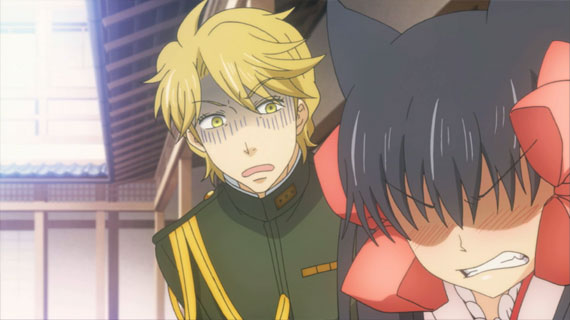
Agemaki looking flabbergasted

“You’re the worst!” …not really the desired reaction, here.

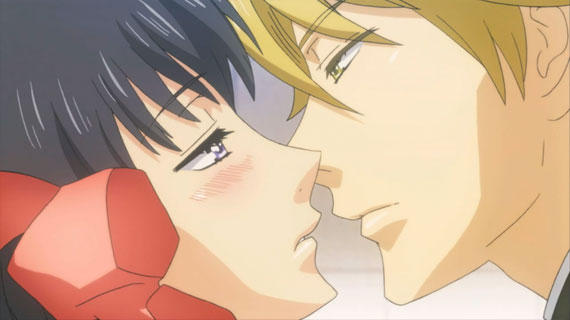
Zakuro and Agemaki about to kiss

THIS is the desired reaction.

Agemaki sprays milk EVERYWHERE

Aaaaaand here’s the aftermath.

Seriously, Hunter x Hunter?

Seriously?

Hisoka gets "turned on"I don’t even want to tell you the context of this image.

I mean, I guess people exist who become sexually aroused by fighting strong opponents (who are twelve years old), but do we really want to be normalizing that behavior? (What do you know, I managed to tell you the context.)

More importantly, who is the target audience? Hunter x Hunterfeels like a cute kids’ show with a tad too much emphasis on fighting for the most part, but then you get stuff like this. What are kids supposed to learn? That it is cool to have some older guy obsessed with you to the point of wanting to get off on hurting you? Or are adults supposed to learn a more sinister lesson?

Aw, look at the cutesy way Gon and Killua imitate Hisoka in the “Hunterpedia” portion of the episode! There’s nothing disturbing about this at all. :P

Gon and Killua do their own schwing

Getting more Japanese language input with Flutterscape

One of the most important factors in learning a new language is getting good input. Interacting with other speakers of Japanese, watching Japanese-language videos, reading Japanese-language books and websites, and listening to Japanese music are all ways you can ramp up your learning.

There are lots of free resources out there for Japanese input. One simple way to find Japanese language content is simply by searching the web for keywords in Japanese.

But sometimes you want something you can hold in your hands, or something that isn’t available digitally. If you’re lucky enough to live near a Kinokuniya or a Japanese specialty store that offers more than groceries, you might be able to find what you’re looking for there. But let’s say you’re really interested in a certain band, and you want to find all their CDs. Or you used to read a translation of a certain manga, and now you’d like to give the original a shot. It’s unlikely that you’re going to be able to walk into a store and find exactly what you’re looking for.

Enter Flutterscape.

Flutterscape is kind of like Craigslist for Japanese media. The site connects people outside Japan who want Japanese products with people living in Japan who have better access to those products. Often the sellers will already have items posted for sale, but what I’ve found most useful is Requests, where buyers can post exactly what they want and then let different sellers bid on the sale. So far I’ve used Requests to purchase two artbooks and two complete sets of out-of-print manga.

The buying process is simple and secure and guaranteed by Flutterscape. Your personal information is not sent to the seller; instead, the seller sends your item to Flutterscape’s Tokyo location, and Flutterscape ships the item to you. You can find more information on buying here.

Obviously, ordering items from another country is going to be a little pricey, especially when you add shipping. Unfortunately, Flutterscape does not currently have a way to combine multiple orders to lower shipping costs; each requested item will be shipped on its own. (I ordered my mangas in sets rather than volume by volume, which would have been cost-prohibitive.) If you like the idea of having media direct from Japan to consume but are leery of the cost, you might consider sharing the cost of materials across a group of Japanese-learning friends in your area.

Regardless, having the option to import items you wouldn’t normally have access to really opens up your language-learning possibilities.

If you are actually in Japan, you can earn a little extra money by being a seller on Flutterscape. You won’t make anything on shipping, but you can (and should) charge the buyers a little more than what it costs you to purchase the item they want. You then get the satisfaction of sharing Japanese language and culture with people around the world while accumulating a tidy little sum for yourself. There’s more about selling here.

As interest in Japanese language and culture continues to grow, Flutterscape has emerged to provide a much-needed conduit for obtaining raw materials. For the right price, you can snag the original manga for that show you were obsessed with as a kid, or out-of-print CDs from that band you heard the first time you started getting into Japanese culture. If there’s something out there you know will keep your interest, it’s excellent fodder for Japanese language study. After all, if you like it, you’re more likely to consume it, which means you’re maximizing your Japanese input. It’s win-win.

Cottage cheese conundrum

I have always loved cottage cheese, and I’ve always been a little picky about it. Since having weight loss surgery, I’ve depended on cottage cheese to help me get enough protein. Unfortunately, I have trouble finding a brand I really like. There seem to be too many things that can go wrong with taste and texture. Here’s a breakdown of all the brands I’ve tried.

Brand Rating Notes
Great Value, large curd, 4% milkfat passable Walmart’s brand is the best I’ve found so far in terms of taste and texture, but it doesn’t bring me joy.
Great Value, small curd, low fat gross Small curd is too dry for me now.
Kroger bleh I can force myself to eat this, but it’s tasteless.
Breakstone’s disgusting Dry, tasteless…why anyone would do this to themselves is beyond me.
Dean’s okay Dean’s is actually better than Walmart brand, but I haven’t found it sold locally, so it doesn’t really help me much.
Mayfield yuck Way too salty. I didn’t think cottage cheese could be salty!
? – Hyatt Place breakfast bar cottage cheese awesome I don’t know where they get their cottage cheese, but I want it.
? – Steak ‘n Shake cottage cheese awesome Another delicious cottage cheese of mysterious origin.

I think Dean’s is the brand I used to eat back in Kentucky. I found it in Augusta the last time I visited; it was the first time I’d ever seen it there. Naturally I bought some and tried it, and it was good. But since I’ve been home I haven’t found it anywhere. Le sigh.

Will the perfect cottage cheese continue to elude me?!

Fringe finale disappointments

There are copious spoilers in this post.

Let me first state that the two-part finale of Fringe was generally enjoyable. There was a nice Fringe event featuring one of my phobias–nanobots (you can’t see them!)–and it was awesome to see Leonard Nimoy return as William Bell, especially in the second half. His performance was excellent. I was intrigued by the notion that David Robert Jones got what he wanted in this timeline: recognition by Bell, even if it meant self-sacrifice. And the new explanation for why Walter had parts of his brain removed was shocking and perfect. I also loved Bell’s escape at the end, which hearkens back to Olivia’s first meeting with him in the original timeline. Makes you wonder if he rode out of there inside someone’s head. The various character wrap-ups were nice too. I appreciated seeing Nina doing some science and being recognized for it. You could tell that the writers had been planning things so that they could end the series here if they hadn’t gotten a season five. (Which perhaps would be better, since season five seems destined to follow the horrid totalitarian Observer plotline.)

But.

The heroes of the day, ultimately, were Walter and Peter. Olivia’s main contribution was to get her and Peter onto Bell’s ship, which seemed more “oh, Olivia should do something heroic too” rather than “Olivia is a vital member of the team”. In fact, it was Olivia, or rather Olivia’s victimization at the hands of William Bell, that threatened to destroy the world. And she had no way of fighting this. All she could do was stand there freaking out. She didn’t even think to kill herself–Walter had to do that for her. (Self-sacrifice would not have been an empowered choice, but at least it would have been her choice.)

Nina makes a big deal about how compassionate Olivia is, and how Bell is using that against her. It is Olivia’s compassion that allows her to become powerful. But based on the events of this finale, we may well conclude that compassion is weakness. Olivia is so compassionate, she can only react emotionally, and is stymied when faced with a dilemma more complex than protecting one person in front of her. She’s powerful, but ultimately she’s weak. She’s just a woman.

That’s the message I was getting.

I would have liked to have seen Olivia control her powers. We saw her doing it in the future of the original timeline, the future that Peter ultimately ended up erasing. The difference with the season four scenario is that she had been dosed with cortexiphan more recently by Evil Nina, to get her up to par with her original timeline self. This probably led to the instability and rapid release of power, provoked by the events Bell put into place around her. But think back to seasons one and two. Olivia–original timeline Olivia–had already dealt with her victimization, with taking care of other victims. She’d found her strength. She’d turned weakness into power and her past into a mission. Would this Olivia really have been flummoxed by William Bell, once she knew what was really going on?

I say no. I say that our original timeline Olivia would have stared Bell down, folded her arms, and calmly turned it off like a light.

Heck, if they’d played their cards right, the writers could have left in the headshot scene, which was actually pretty cool. Just as Olivia figures it out, Walter shoots her in despair. Peter freaks. But the bullet goes all the way through and Olivia’s cortexiphan-infused brain self-repairs instantly. Bell, about to flee, stops to gloat as the universe-destruction starts up again. And then Olivia drops the hammer on him. Later, in the denouement, Olivia undergoes a series of tests and discovers that excessive use of her powers causes an enormous drain on her body and might threaten her life, so they should be treated as a last resort.

(I’d like to keep the part where Walter removes the bullet, because that scene is just crazy, but I’d also like for Olivia to be able to stare William Bell down as she’s turning off her powers, and I’m not sure he’d stick around after he thought she was dead.)

My rewrite would allow Olivia to keep her powers without becoming some sort of overpowered superhero. It would give her an advantage in a universe populated with (male) scientific geniuses, other than her photographic memory and detective skills, which haven’t really seen much use lately. It would also bring back the feeling from seasons one and two, when the main character of Fringe was a strong woman who fought her own battles rather than feeling like a victim and waiting for her white knights (or rather, Bishops) to save her.

My new anime love: Kids on the Slope

Kids on the Slope坂道のアポロン (Kids on the Slope) is a story about jazz-loving high school students in Kyushu in the 1960s. I’ve been watching it on Crunchyroll. The series is directed by Shinichiro Watanabe, who you may remember from the fabulous Cowboy Bebop, and the music is by Yoko Kanno, whose amazing music is everywhere–Bebop, Macross Plus and Frontier, and Escaflowne, just to name a few. (There’s even an iPhone alarm clock app from UNIQLO featuring original Yoko Kanno music now.) The art is nice and the animation flows well, and of course the voice acting is top-notch.

The show’s got plenty of the pieces I look for: an interesting setting, believable characters with pasts that are revealed as the story unfolds, a purpose bringing the characters together. I love that it’s not set in Tokyo. I love that it’s the past, and that it feels so well-researched. I love that everything is infused with jazz music. I love all the “love” relationships that at first seem so simple and then get more and more complex, just as real relationships do.

And I love that this is a show that is unafraid to go there. In the fourth episode, our heroes are playing their first live concert, and they’re really getting into it, when all of a sudden a surly drunk American soldier starts yelling at them to “stop playing that [expletive] music and play white jazz”.

Of course that would happen. It was completely realistic. And the characters’ reactions are just as realistic. Sentaro, the drummer, who is half white, half Japanese, is extremely sensitive to this sort of issue. He yells something like “Fuck that segregationist shit!” and storms off the stage. Another character, Jun, calmly rallies the piano player, Kaoru, and the two of them perform a soft jazz tune, which placates the drunkard.

I feel sort of bad for being so surprised at the scene. I’m just not used to seeing racism so blatantly portrayed in anime–especially with Japan as the setting. In an imagined setting, you can more safely explore this sort of theme without implicitly accusing a culture of bigotry. Not to put too fine a point on it, but Japan is by and large a homogenous country, and racism does exist there, as you can see in the story of what happened to a guy today on a train in Nagoya. Having racism as a story element is an extremely brave thing to do because it’s going to make people uncomfortable (as it should). You could argue that having the racist be a white American absolves the Japanese characters, but he’s just the loudest example of racism. You see plenty of quiet, cruel racism towards Sentaro from his own family members in flashbacks. I think putting in the soldier, having him be blatantly racist, makes the other racism more obvious, and makes Sentaro even more relatable.

It’s rare for me to have such a strong reaction to a show after only having seen four episodes. It took me a long time to process how I felt about that last episode in particular. I love that this is a show that takes the time to do character development well, but doesn’t actually waste any story time. Plenty of stuff happens; time seems to pass quickly. But at the same time I feel like I’m slowly untangling a glorious mess of thread and seeing how it all ties together. This is not shut-my-brain-off entertainment; this is the kind of engagement that comes from true storytelling. And I love it.

Feminism and Fringe

Fringe has been one of my favorite shows ever since it began. I loved the focus on a strong female lead who attacked problems head-on and who, at least in the beginning, provided direction for the group as a whole. But I’ve recently started to notice a few troubling details that make me wonder whether the writers are working with unconscious sexist assumptions.

Really, it all started with the horrid episode 4.19. It struck me as very odd that Olivia and Peter’s daughter should be, essentially, a clone of Olivia, and not have any of Peter’s scientific genius. This made me start to think about the female characters in Fringe in general, and I realized that none of them is really a match for Peter, Walter, William Bell, David Robert Jones. There are no genius woman scientists in Fringe.

Nina is said to be a scientist, but we rarely see her doing anything related to science. More often she is managing Massive Dynamic or directing others to perform scientific experiments. She can’t even repair her robotic arm on her own.

Astrid has a gift for computers, languages, and code-breaking, but more often than not she is relegated to the tasks of lab assistant and babysitter. We have never really seen her take the lead on a project, though she may make small observations that help the show’s featured geniuses arrive at a conclusion.

Other than that, we have the Fringe events of the week, some of which involve women, but usually those women are either pawns or are using technology they got somewhere else. We have had no main scientific antagonists who were female.

Do the writers of Fringe believe on some subconscious level that women can’t be genius scientists? Is this why there are no female Observers? (If what September said was true, and the Observers are the future of humanity, this implies that humanity evolved away from, or forcibly shifted itself away from, having two sexes. Are we to believe this is because women were inferior scientists and could not “keep up”?)

This all comes as the show has shifted its focus away from its protagonist, Olivia, to focus on Peter. Suddenly Peter is the one who has remained the same throughout all four seasons, not Olivia. Our base of “normal” is no longer Olivia, but Peter. We don’t see Olivia directing the action anymore…instead, she reacts. Things happen to her. At the very end of 4.20 she started to take control again, but after a full season without that strength, it didn’t feel like enough to re-cement her protagonist role. And we already know that in the ridiculous totalitarian Observer future, Olivia isn’t even there.

It’s just all very troubling, and I wonder if the writers see it.