The tablet-laptops are on their way

I previously wrote about my new obsession with tablet-laptop hybrids, and my specific fascination with the Acer Iconia W5. Now, thanks to Sean and Ars Technica, I am aware of the Ativ Smart PC 700T1C from Samsung.

Lookit.

Samsung Smart PC Pro 700T

It’s sleeker than the W5. It also supports 64-bit Windows and has an Ivy Bridge processor. The resolution is better–1920×1080 vs. the W5′s bizarre 1366×768. The max 4GB of RAM is a concern, but this problem seems to plague all tablets.

I like that it works with a stylus (“pen”). The reviewer had concerns about the size, but I guarantee my hands are smaller than his. You can’t flip the screen around on the dock, but as I mentioned in my post on the W5, that feature was more of a bonus than a must-have.

It bothers me a little that it appears you have to buy the pen and the keyboard dock separately, meaning the list price is misleading. But I don’t think they add too much to the price–the stylus certainly doesn’t.

Ultimately I’d love to see one of these in person and get a feel for how it would be to own one.

The ways we mourn

Boston skyline

Boston, summer 2004

Some of us lay our souls completely bare to everyone around us.

Some of us find comfort in helping–sharing information, searching for resources, offering a shoulder, donating.

Some of us stare mutely and refresh, refresh, refresh.

Some of us look for a reason, any sort of logic behind it all.

Some of us seek someone or something to blame.

Some of us lose hope.

Some of us find strength.

Some of us cry, alone, and push forward because it’s all we can do.

There are so many ways. But in the end, we all mourn.

Keyword hell

mass of unnecessary keywordsI have spent a lot of time these past few months organizing my personal photo site at SmugMug. I made sure all the photos I wanted uploaded were uploaded; I created new Categories and Subcategories and moved galleries around; I did a bunch of captioning and keywording that I’d put off (with still more left to go).

Then I thought I’d organize my keywords to make my photos easier to browse. I knew I had some photos with the keyword “southcarolina” while others used “south carolina”, for example; I was able to go through and bulk change all of these to match each other.

keywords-130415In the process of doing this, though, I discovered something horrible.

You see, for as long as I’ve been taking photos, I’ve been renaming all my files to use a variation on the filename template of my first digital camera, the Olympus C3030 Zoom. This means photos taken today will have filenames like P04150001.jpg. I did this so I could easily view my photos locally and sort them on SmugMug in the order of my choosing–simply sorting by date taken doesn’t always work, especially with multiple photos from the same day but different cameras, or photos copied from someone else, or scanned files.

Some time back, SmugMug implemented a change that now causes keywords to be automatically generated from filenames. And ever since then, each of my photos has been tagged with an unnecessary keyword. This has resulted in a ludicrous list of keywords; I’ve made a screen capture of about one-fourth of it.

I’m not holding this against SmugMug; it seems like automated keywords would be useful for many people, and I am able to turn the feature off (and I did as soon as I realized what was happening). Unfortunately, though, this unique set of conditions has left me with a metric ass-ton of work.

You see, there is no way to manage many keywords globally at once–deleting, renaming and the like. You can manage single keywords at once, which is how I changed “southcarolina” to “south carolina” across my entire photo site. And you can of course manage keywords by gallery, which is how I assign them and edit them in the first place. But you can’t, say, select a group of keywords and hit a delete button.

What I can do is click on the keyword, which takes me to the photo, then click on the “See photo in original gallery” link. From there I can use the Caption / Keyword tool to edit all the keywords in that gallery.

However, even from that screen there is no way to delete keywords in bulk. I can’t use wildcards to find and replace or find and remove keywords. And though SmugMug has a “Remove Numeric” keyword option, it only works with keywords that are made up of all numbers, not alphanumeric keywords. So I must scroll through the entire gallery and manually delete the unnecessary keyword from each photo.

Take a look at the keyword screenshot again and try to imagine how much work this is going to be.

Actually, I can help you with the scope. I highlighted all the keywords and pasted them into Word to get a count.

There are 9,638 keywords, each of which applies to either a single or a small handful of photos.

Nine thousand, six hundred thirty-eight.

That’s nearly ten thousand keywords, with even more photos, scattered across hundreds of galleries.

Yeah, this is going to be fun.

Possibility dawns

As I edged back into consciousness in the lingering dark of early morning, a sound I don’t normally hear rang out from within the forest I knew lay beyond my blinded window. It was the call of an owl, trilling one-two, one-two, one-two, then subsiding. The pattern of soft, throaty cries repeated twice before finally fading away.

If I hadn’t awakened at just the right moment, I’d have missed it.

I went to the kitchen, where I discovered I was out of the Atkins chocolate shakes I usually have for breakfast. But my nonstick pan was right there in the sink from making home fries last night, so I washed it and set it on the stove. I’m out of Country Crock, too, but I’ve been wanting to shift to real butter. I halved the chunk of stick left in the fridge, then halved that and set one bit to melting in the microwave and the other to melting in the pan.

When the microwave half was melted I used a basting brush to coat two slices of wheat bread with it. While the buttered bread toasted, I fried two eggs over medium, one at a time, cracking them into the center of the pan and sprinkling them with pepper and salt.

Eggs over medium and buttered toast

I brought my morning meal to my desk and sat and ate as the dim light beyond my office window shifted from dark velvet to paint palette blue to breathlessly pale.

A cherry blossom adventure in Conyers

March, for the most part, was cold and miserable, with occasional freak snow flurries in the mornings. Trees only haltingly started blooming toward the end of the month.

I had known for some time that Macon had a Cherry Blossom Festival, and I’d made tentative plans to go…but the forecast for my intended weekend, March 23 and 24, was horrendous, chilly and rainy. Given the weather of the previous few weeks, I estimated that the cherry trees wouldn’t even have been in bloom anyway.

The next weekend, though, felt just right for cherry blossoms. While I didn’t quite have time for a road trip to Macon, I figured I could find some trees closer to home. A bit of googling turned up the fact that there had been a cherry blossom festival in nearby Conyers, Georgia, the same weekend as Macon’s. According to the website, that city has plenty of cherry trees to enjoy. I was busy with chores on Saturday, so on Sunday, March 31, which happened to be Easter, I headed east on I-20 to the town I always pass going to and from Augusta.

I’d read that both downtown Conyers and the nearby Georgia International Horse Park had lots of cherry trees. I decided to hit downtown first, as I love exploring small towns. Conyers did not disappoint! Not only did I find the cherry blossoms I was after, but I saw a cute and vibrant downtown and plenty of other flowering trees and plants.

Cherry blossoms in downtown Conyers, Georgia

Evans Pharmacy, Conyers, Georgia

Fallen blossoms, Conyers, Georgia

Downtown Conyers even has its own miniature botanical garden.

Lewis Vaughn Botanical Garden, Conyers, Georgia

Lewis Vaughn Botanical Garden, Conyers, Georgia

By the time I’d explored Main Street and the Lewis Vaughn Botanical Garden, I was pretty tired and thirsty, so I stopped at Creamberry’s Ice Cream–the only open store I saw downtown–and got a sundae and a bottled water.

Creamberry's Ice Cream, Conyers, Georgia

Sundae and water at Creamberry's Ice Cream, Conyers, Georgia

After that it was back to exploring. I found a few interesting buildings as I approached the train tracks, and when I actually got to the tracks, I discovered the cherry blossom mother lode.

The Pointe Tavern, Conyers, Georgia

Cherry blossoms along train tracks in Conyers, Georgia

The overcast sky started to clear up just then, so I was able to get some reasonably good shots.

Cherry blossom, Conyers, Georgia

Colorful buildings, downtown Conyers, Georgia

Cherry blossoms, Conyers, Georgia

When I reached the end of the long line of cherry trees, I turned back in toward downtown Conyers, passing the Welcome Center and cutting through to the public parking lot where I’d left my car.

This probably would have been enough, but I still felt like exploring, so I charted the way to the Georgia International Horse Park with my phone. After all, if the cherry blossom festival was held there, there had to be more cherry blossoms, right?

At first I was disappointed, though. Road construction detoured me away from the main entrance, and I ended up driving onto the horse park through a side gate. There were barely any trees at all around the stables and tracks, let alone cherry trees. I drove around the perimeter and didn’t see anything worth stopping for beyond a creek I’d noticed upon arrival. Disheartened, I took the first exit I came across back to the road…and across the street I spotted a nature preserve. I hopped across the road into the parking lot, parked my car, and marched down the hiking trail without a second thought.

Big Haynes Creek Nature Center is nestled along the creek I’d seen from the horse park. The trail led me back through the woods to an absolutely gorgeous wetland area.

Big Haynes Creek Nature Center

The trail winds along a large body of water, upon which I saw Canada geese, a heron, and a surging splash in the distance that may have been a beaver or muskrat (or an alligator). I spent considerable time sitting at the boardwalk area, basking in the beauty I’d found.Boardwalk at Big Haynes Creek, Conyers, GeorgiaHeron, Big Haynes Creek, Conyers, GeorgiaBig Haynes Creek Nature Center, Conyers, GeorgiaBeyond the boardwalk, the trail curves into the forest alongside the creek, past a water purification plant and eventually back to the parking area. Along the way, educational signs and activities share information about local plants and wildlife and the water purification process. I even saw more flowers. It’s a really nice little nature center.

Flowering vine along Big Haynes Creek, Conyers, Georgia

At this point, I was fully satisfied with my Conyers adventure. I got back on the road expecting that to be it. But I ended up leaving the Georgia International Horse Park property a different way than I’d come in, and that meant I finally found the main entrance–and its stands and stands of cherry trees.

Cherry trees at Georgia International Horse Park, Conyers

The cherry blossom-lined road out of the horse park was the perfect endcap to an amazing adventure in Conyers.

More photos | Buy prints

A glorious day in Midtown

Midtown skyscrapers

In my post about second homes, I mentioned that I hadn’t quite made that special connection with Atlanta yet. This past Tuesday, I realized that’s not exactly true. I do have strong feelings…for parts of Atlanta.

It only makes sense. Atlanta is huge. The sprawl just keeps going and going. Much of the city is strings and clusters of strip malls, businesses, and homes that are only accessible by car. Of course I wouldn’t find that homey, walkable, or natural.

But there are places where I can stroll around happily for hours and find plenty to do and see. As I rediscovered Tuesday, one of those places is Midtown.

Midtown skyscrapers

My friend and former coworker Stephanie just moved back to the Atlanta area–we met in Augusta, but she grew up here. We’ve been trying to get together and do something for awhile, and finally this week things came together. She and her baby Landon, who is just about to start walking but for this day spent most of the time in his stroller, met up with me at the High Museum of Art.

High Museum of Art with signage for Frida and Diego exhibit

Stephanie hadn’t been there since she was in school; as for me, the last time I’d visited was for the Picasso to Warhol exhibit a year ago. I acquired a photography permit (something I don’t recall them doing last year) and signed a statement agreeing not to post my photos online (alas), then we got to exploring.

We started in the Stent Family Wing, heading up the ramp to see European Art from the 14th to 19th centuries and American Art from the 18th to mid-19th centuries. We took a short break so Stephanie could feed Landon; I was impressed with how organized and thoughtful a mom she is. After a quick diaper change, we were able to take in the first part of the visiting Frida & Diego exhibit before Landon became too fussy to continue. All the while, Stephanie and I chatted about the art, and travel, and cutie Landon, and it was a lot of fun!

I wasn’t quite ready to leave yet, so after walking Stephanie and Landon down to the lobby, I headed back up to finish out Frida & Diego. I hadn’t heard of Frida Kahlo or Diego Rivera before this exhibit came to town, so it was an eye-opening experience. They both had such fascinating lives, their relationship with each other a pivotal point. One of Frida’s paintings in particular, “The Broken Column,” so strongly resonated that I had to fight burning tears. Frida suffered crushing injuries in an accident when she was 18. Her spine was broken in multiple places and her uterus was impaled. These injuries left her in a lifetime of pain and unable to carry a pregnancy to term. She died young, at 47. “The Broken Column” is a self-portrait. Frida gazes at the viewer, standing tall despite the exposed, fractured column that represents her spine, her body riddled with nails, her face streaked with tears.

All of the Frida & Diego exhibit is amazing and informative; I highly recommend checking it out before it leaves Atlanta in May.

After Frida & Diego I went up to the Skyway Level to see Gogo: Nature Transformed, a temporary exhibit of jewelry based on designs found in nature. Much of it was cast from molds of animal bones, and I didn’t really care for it. After that I wandered through the Modern Art exhibits, which were far more to my liking. I especially enjoyed the furniture designs; the High has pieces from Frank Lloyd Wright (instantly recognizable) and pieces that were sold by Herman Miller in the mid to late 20th century. One thing I also appreciated about the Modern Art exhibits, and the others that incorporate furniture or sculpture, is the way the museum has arranged all the pieces. Designing an exhibit is an art unto itself.

After Modern Art I skipped Folk Art and went straight to Contemporary Art. I remembered many of the pieces–Anish Kapoor’s untitled reflective dish, for one–but new items had appeared as well, and other exhibits and pieces that were on display last year are now gone. Then I went down to the Third Level and looked at American furniture, paintings, and sculpture from the 19th and 20th centuries. Items I found especially fascinating were an ornate cabinet, an intricate piano built for its looks rather than its sound, a group of face jugs from Edgefield, South Carolina, and two separate still life paintings featuring dead fish.

Finally I went down to the Lower Level, where I strolled through the Works on Paper exhibit and the African Collection. I found myself drawn to three paintings by Will Henry Stevens in Works on Paper and a display case filled with intricately detailed metal curios in the African Collection. And with that, my wonderful five and a half hours at the High were concluded.

High Museum of Art

At that point I was pretty hungry, so I decided to try and find food. I’d had a protein bar at around noon, but it was now 4:30. At first I thought I’d just go to the restaurant next to the High, but nothing on their menu sounded appealing, so I got on Yelp! to see what was available in the area. Unfortunately, the Midtown branch of South City Kitchen wasn’t open yet. I tried to go to a place called Article 14, but I couldn’t find it. (I ended up passing it later in the evening on a completely different street from where I’d been looking, but in my defense, the streets are both called Peachtree.) Eventually I decided to just keep walking around and eat whenever I found a restaurant that looked good. It took about 45 minutes, but I finally came across a pizza place called Vespucci’s, so I stopped there and had a delicious pepperoni calzone.

Pepperoni calzone from Vespucci's

Thus recharged, I decided there was still enough daylight to warrant going to Piedmont Park, so I headed off down the other Peachtree Street and then up 14th Street, all the while taking photos of beautiful Midtown. I got to the park at around 6:30 and spent about 45 minutes strolling through it, circling the pond and snapping photos of flowering trees and shimmering water. It was pretty out, though it was starting to get cold; I kept my hands in my pockets as much as possible.

Flowering tree at Piedmont Park

Flowering tree at Piedmont Park

Midtown skyline as seen from across the pond at Piedmont Park

Detail of a flower on a tree at Piedmont Park

Pavilion on the pond at Piedmont Park

Visitors Center at Piedmont Park

I took more Midtown shots on my way back to the car. The setting sun made for some nice light.

Reflected skyscraper bathed in a wedge of sunset light

Sunset light washing over 14th Street

I was headed off for home before darkness had a chance to settle in, thanks to Daylight Saving Time. (I may be the only person who likes DST.) As I found my way back to I-75, the dwindling sunset painted Midtown pink.

Pink-hued Midtown skyscrapers

I’d had an awesome day, but somehow I didn’t want to go home yet. I called Sean to see if he wanted to go out to dinner, but he didn’t, so instead of going to the apartment, I drove to our local movie theater to see if they had anything interesting. At the time, my mood was swinging toward either Emperor or A Good Day To Die Hard, but neither was playing at that location. Oz the Great and Powerful was available, but I’d read a review that had somewhat soured me on seeing it…so I went back to my car and pulled up Yelp! again, deciding to just go ahead and have dinner. A search for nearby restaurants revealed a Thai/Malaysian place in an adjacent shopping center. Given my love affair with Penang, that sounded like a plan to me, so I hopped out onto Cobb Parkway and then right off again, heading straight back to Top Spice.

The ambiance wasn’t quite as cozy as Penang’s, at least not in the entryway. I felt rather like I was on stage, as all the tables were raised above the level of the front door and there was no half wall or anything to provide a feeling of privacy. Once I was snug in my booth, though, I was quite comfortable.

Interior of Top Spice

Rather than an entree, I decided to have two appetizers. This was mainly because they had roti canai and I love roti canai, and I knew if I got roti canai and an entree, I wouldn’t be able to finish. The second appetizer I chose was called martabak. It’s made with the same Malaysian “pancake” as roti canai, but it’s a beef and onion curry wrap. Somehow the flavor wasn’t what I was expecting, and I’m not sure I liked it. The roti canai was good, but Penang’s is better.

Then I gave in to temptation and tried their sticky rice mango, and it was amazing. The plate featured three separate items: a sticky rice patty with sesame seeds, a neat pile of mango slices, and a small bowl of coconut syrup. At first I tried alternately dipping the rice, then the mango into the syrup, but I soon found that assembling bites of all three at once created the ultimate flavor. Sticky rice mango is one of the most delicious desserts I’ve ever tasted. I devoured it all.

Sticky rice mango at Top Spice

With that satisfying conclusion to my meal, I was finally ready for my day of adventures to end. I headed home in sublime contentment, my belly full of yummy food, my camera full of photos, and my brain full of happy memories.

View more Midtown photos | View more March 2013 photos

Genealogy

I’ve added a Genealogy Resources list to my links. I’ve always been interested in family histories; my grandfather put together a 72-page book charting our family from Wales across Virginia and Kentucky when I was a kid, and some years ago I was contacted by a distant relative in Texas who sent me a huge printout of his own Aubrey family tree research going back even further. (Unfortunately, I lost all that stuff in the fire.) I’ve used Ancestry.com off and on for a few years, messing with a couple trees here and there, but that was about the extent of my forays into genealogy until today.

Yesterday on Twitter, my friend Chris linked to a site I hadn’t heard of before: Find a Grave. It’s an amazing resource, containing listings for 95 million grave sites. I spent some time there today, putting in entries for my grandparents and great-grandparents and a great-uncle and creating “virtual cemeteries” (groups of family members) for Dad’s family, Mom’s family, and Sean’s family. I barely scratched the surface of what’s available, but I’ll need to do more in-depth research to continue.

In the course of searching for information to put in the listings, I discovered this detailed description of Grandpa’s book, which filled in some gaps in my memory. I had been pretty sure my immigrant ancestor’s name was John, but that was all I could remember.

Henry Awbrey (d.1694) immigrated from Wales to Rappahannock County, Virginia about 1663. John Awbrey (ca.1623-1692), brother of Henry, immigrated from Wales to Westmoreland County, Virginia. Descendants of the brothers (chiefly spelling the surname Aubrey) lived in Virginia, Kentucky, Georgia, Alabama, Texas and elsewhere. Includes family history and genealogical data about ancestors in Wales, England and elsewhere to about 1066 A.D.

I’m really happy to have this information. Hopefully someday I can find an actual copy of Grandpa’s book, too. When I do, I’d love to put it online, but I’m not sure how copyright works for something like this. Grandpa didn’t make his book for profit. He and Grandma have passed away, so I’m not sure who the rights would fall to. I do recall Grandma telling me that someone from Grandpa’s family had asked for all his research; perhaps that person was given the publication rights as well? I’d love for Grandpa’s book to have a broader audience than just the few who managed to snag copies of his hand-typed, photocopied, center-stapled self-publication.

I’ve been thinking recently that I’d like to design a robust genealogy web application. There are many features I’d like to incorporate, like family home information (pictures, locations, the dates family members lived there); the ability to create/generate matrilineal trees; information and timelines on events that involved multiple family members, with general summaries for everyone and the capability to add notes specific to each person; and whatever else I can think of, with all data cross-referenced and available in an API. Of course, something like this may already exist; I’ve barely dipped my toe into genealogy. I’m just fascinated by the idea of archiving lives in creative, robust ways.

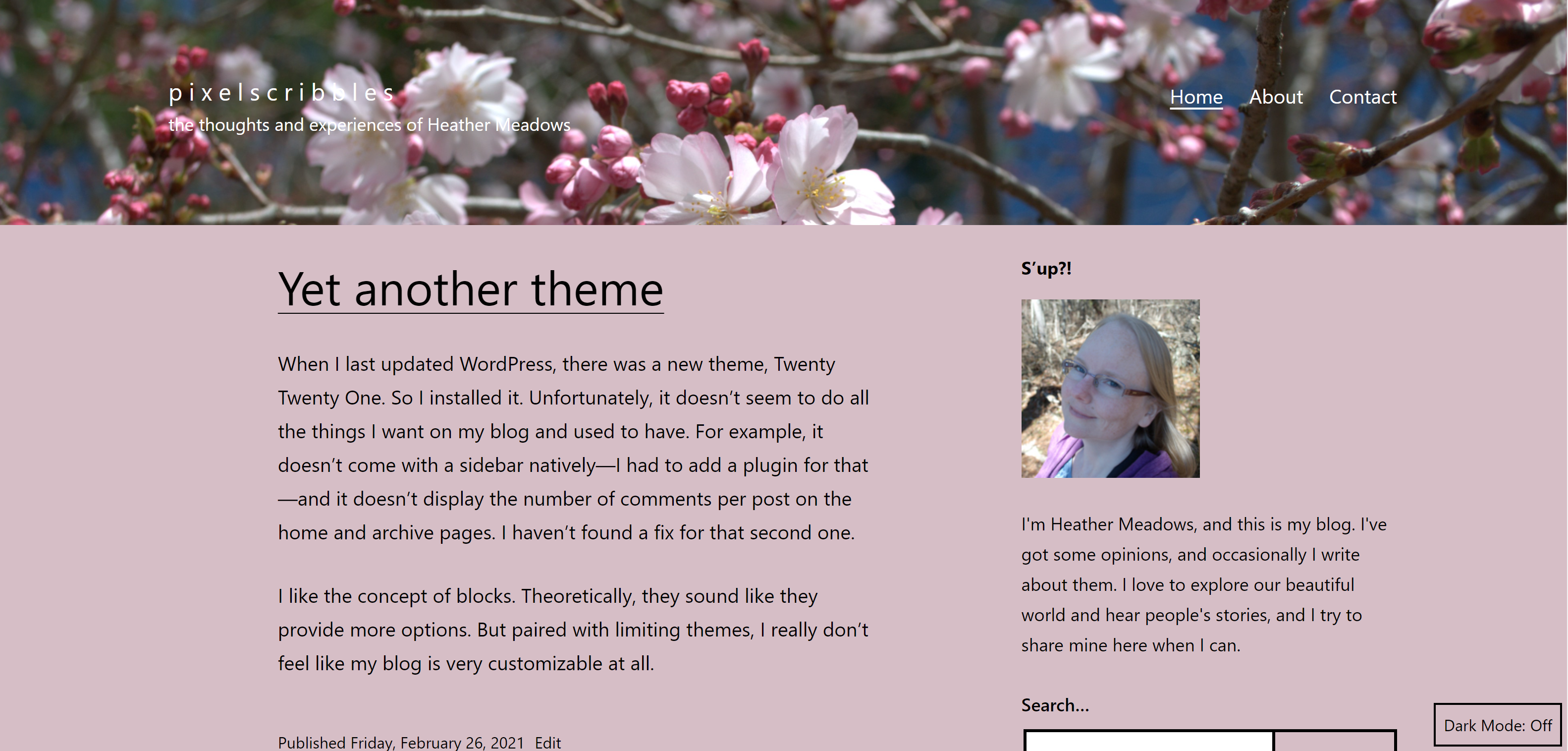
New blog header

I got tired of looking at Roche Abbey (no offense, lovely site of my birthday picnic of 2009!), so I put up a photo from last year’s jaunt to Sweetwater Creek State Park. Here’s how my blog looks at time of writing (click to embiggen):

pixelscribbles screenshot

Second homes

There are certain places that I start to feel connected to and even possessive of as I learn about them, visit them, or live in or near them. From my childhood, there’s Chicago; I only visited a couple times with family, but for some reason I developed a sense of belonging that has never faded. I recognize Chicago buildings and I can still remember visiting museums and driving along the waterfront. When I hear news about Chicago I feel almost as if I’m hearing news about a place where I’ve lived. And I’ve always thought Superman’s Metropolis should be Chicago, as Gotham City should be New York. It just seems to have the right tone.

From my first foray into adulthood, there’s Huntsville, Alabama, the city in which I first lived away from home. In Huntsville I gained new freedoms I’d never had living with my parents; I rode my bicycle all over and caught rides with friends to places in town. To this day I feel possessive of Sparkman Drive and the Eggbeater Jesus. I’ve been lucky enough to visit Huntsville in recent years, once in 2009 and twice last year, and the lovely changes to downtown and the cool new restaurants and shopping centers make me swell with pride, even though I had nothing to do with any of it.

Then there’s Austin, which I visited once briefly in 2000…somehow that city got under my skin and never left. Walking around downtown with Sean (who I was simply dating at the time), Ben, and some friends we’d met online, I felt “cool”. And that fast food sushi place blew my mind; Japanese food wasn’t ubiquitous back then. I remember being told that Austin was “the Silicon Hills,” that there was a tech explosion on the horizon, and I loved the lushness of Austin compared to the dry, flat areas of Texas we’d had to drive through to get there. These days an old friend of mine lives in Austin, as well as family; I also follow people on Twitter who live in Austin, and I pay attention to the Austin web scene.

Next is Augusta; as I lived there for eight years, its “second home” status is more than legitimate. Even though we moved away nearly two years ago, I still feel more connected to Augusta than I do to Atlanta, or even to our little corner of it. I had many friends there, and working in news gave me plenty of local insight and the opportunity to attend lots of local events. I love Augusta. Its weather is great, downtown is charming, outdoor activities abound, there’s plenty to do within a day’s drive (including going to the ocean or mountains), and the tech scene is vibrant. Since I’ve left it seems like Augusta is really ramping up; it makes me want to move back.

York, England is another city that made me feel oddly like I belonged. There was just something about it. The city is beautiful and walkable and features the gorgeous York Minster as well as an amazing tea shop. Brooke and I were only there for a day, but I could have easily spent a week; I wouldn’t say no to living there if given the opportunity.

Then there’s Birmingham, Alabama. For awhile there Sean was traveling for work a lot, and many of his trips were to Birmingham. As it’s just a couple miles west of Atlanta, I was able to tag along twice. I fell in love with the beauty of the city, its dedication to history, the many cultural activities that are easily accessible and free, the variety of restaurants, the city’s gardens and natural beauty. Visiting Vulcan was loads of fun despite the rainy weather, and I was excited to find Electra and the Temple of Sibyl on my jaunts through town. Sloss Furnace is gorgeous; I could see myself exploring those overgrown industrial ruins over and over again. And I love the Japanese section of the sprawling Birmingham Botanical Gardens. A friend of mine and his family just moved to Birmingham, and I must admit to being a little jealous.

Poughkeepsie and Beacon in New York state also felt like home. Unique, beautiful, and comfortable.

There are some cities I’ve been to that haven’t had this effect on me. Though I’ve visited Savannah many times, I don’t feel that connection. I like it there, but there’s no sense of mutual belonging. The same goes for San Francisco; during my trip at the end of 2011 it seemed like a lovely place, but I’m not sure I would live there.

If there’s a trend to all the cities that feel like home, it would seem to include cool downtowns, lovely architecture, natural beauty, and walkability. Those last two items were large factors in choosing our current apartment in Marietta; I’m also pleased to note that Marietta has a cute downtown, though parking can be something of a hassle. The Atlanta area is huge, and it’s taking me awhile to develop that sense of comfort that comes from knowing what I’m doing in a city. But with everything Atlanta has to offer, I think I should eventually be able to call it another of my second homes.

Tablet-laptops

My current computer is a laptop from Sager. It’s fairly large. I’ve taken it on trips home to Kentucky, and I even lugged it to a web convention once, but given its size I prefer to use it at home, with speakers, a mouse, and a keyboard plugged into it. The screen is nice and big and I use the keyboard and mouse to sit a respectable distance back from it. The speakers add to the desktop feel. This is not a computer I really like taking places; I have to detach everything, crawl under my desks to unplug and slip out cords, and then pack it all up in a large laptop bag. It’s very heavy.

For some time now I’ve dreamed of owning a tiny laptop, perhaps a netbook, something I could use for the general mobile computing currently achieved through my iPhone. While the phone is very convenient for things like Twitter and Facebook and even email, I hate browsing the web or writing documents on it. After using the phone for extended periods, I sorely miss having a keyboard.

I’ve never particularly wanted a tablet. They’ve always seemed inconvenient to me; you have to hold them, typically, unless you have a stand, and the stands generally aren’t as adjustable as I’d like. I usually watch movies and such on my laptop or TV, and I do most of my digital reading on my iPhone. (In fact, though I own a Kindle, I’ve read most of my Kindle books on the iPhone Kindle app.) The only thing I’ve ever wanted a tablet for is cooking: I’ll pull up a recipe on my phone sometimes, but the screen is small and shuts off automatically, and as I don’t feel like adjusting settings every time I cook, I end up having to unlock the phone multiple times throughout the cooking process. A tablet, I’ve thought, would be nicer, something I could mount in the kitchen, something with a larger screen that would stay on and be easy to read. But since that would pretty much be the only thing I’d use it for, I could hardly see how that would be a worthwhile purchase. It would be better, I thought, to get that tiny laptop.

I haven’t spent a lot of time looking for something, though. Ultimately I figured I could just deal with the hassle of moving my giant laptop when the situation warranted it. I had no pressing need for a spare laptop, anyway.

But then I was at Fry’s with friends last month and I saw the Acer Iconia W5.

Acer W510Look at that thing.

It is gorgeous.

It’s a touchscreen Windows tablet with a keyboard dock. You can bend the screen back at any angle, twist it around, flip the keyboard to serve as an adjustable stand for tablet display and use. You can undock the tablet and just use it by itself. The keyboard layout is great, and the touchscreen means there’s no need for a mouse.

It’s tiny. It’s light. It would fit in a small bag. The display, at least to me, looks great.

Upon sighting this extraordinary creation I was filled with a technological longing I haven’t experienced in perhaps a decade. Sure, I like new things, but for the most part I’m pragmatic about gadgets. I view everything with a healthy dose of do I really need that?

But this. This would do everything.

I could stand it up in the kitchen for recipes. I could take it to Kentucky instead of lugging my huge laptop. I could bring it to conferences and not take up egregious amounts of space. Heck, I could take it to coffee shops. I could run regular desktop applications, not just apps. I could install programs.

Sean has no problem budgeting for something like this, but he said I should look into other options to make sure we find the best one. Since then I’ve done a little poking around here and there, and I’m not really finding anything like the W5. There are plenty of tablets with stands, and some that come with keyboards, and some that have keyboards built into their covers, but nothing quite like this. No adjustable hinge for the screen. No built-in keyboard with standard layout (and extra battery).

Ars Technica’s review of the W5 isn’t exactly glowing, however. There are concerns about the hardware not supporting 64-bit Windows, and the plastic construction. The performance apparently isn’t as great as tablets with Intel’s Ivy Bridge processor.

I read a review of the Windows Surface Pro by Gabriel from Penny Arcade, and he says that device is great for hand-drawing and gaming, something I’m not sure the W5 can do. Then again, I don’t do either of those things. (Ars has some issues with the Surface Pro, and it doesn’t have a keyboard dock, just a case with a kickstand.)

The Asus VivoTab RT has a keyboard dock, and its construction seems to be much better than that of the W5, but it’s a Windows RT machine, meaning it runs apps, not full programs.

This brief rundown of upcoming tablets seems to indicate that there are or will be plenty of these “hybrids”, which the author says can be classified as tablets with keyboard docks or as laptops with removable screens.

At this point I’m not sure there’s anything else out there that would give me what the W5 offers. But it seems like this trend of hybrids is only beginning, so perhaps I should wait until more products are on the market.

Based on my research, I can at least conclude that I want the following features:

  • Touchscreen tablet
  • Keyboard dock
  • Form factor adjustments better than a simple kickstand; a stiff hinge is necessary, and the option to swivel and/or present the screen differently would be a bonus
  • Windows 8 full (not RT)