The Ballad of Narayama

The Ballad of NarayamaLast night I watched the 1958 Criterion Collection film The Ballad of Narayama on Hulu. This film deals with the possibly mythical tradition of ubasute, literally “discarding the elderly”. While Hulu’s plot summary made it seem as though the film is about a man struggling with having to leave his mother in the mountains to die, much of the story comes from his mother’s perspective. I would characterize this film more as the contrasting reactions of a very close mother and son to a tradition that forces them apart. (Criterion’s plot summary is much better.)

Where mother Orin is profoundly interested in tradition and saving face, son Tatsuhei is more strongly affected by the now, by the people and things he personally cares about. This contrast is plainly evident from the very beginning of the film; Orin is excited to have found a new wife for Tatsuhei, someone who can take care of her son once she’s gone to Mt. Narayama to die. Meanwhile, Tatsuhei is still mourning the loss of his first wife, and the thought of a new one simply causes him to worry about food supplies and remind him that he will lose his mother soon.

Tatsuhei’s son Kesakichi, a worthless layabout who has gotten his girlfriend pregnant, is often a catalyst for dissent in the family. He objects to getting a “new mother”, wanting to maximize available supplies for his girlfriend. He incites the local children to sing songs about demons with 33 teeth, which shames Orin, who at 69 still has 28 teeth. She is so unhappy that people and gods might think she is prideful or that she won’t accept her death at 70 with grace that she smashes her mouth into a cooking pot to break and knock out her own teeth. Tatsuhei is horrified; sobbing, he insists that Orin eat the special treat of white rice she has made for the festival, frustrated at the idea that she might no longer be able to enjoy food.

As Orin continues to put her affairs in order, Kesakichi continues to be obnoxious, bringing his girlfriend to live with the family and giving her most of the food, asking Orin when she’ll be going to Narayama. His girlfriend becomes bold too, joining in on these torments, but Orin accepts it all calmly, repeating that she’ll be going to Narayama at the New Year, the year she turns 70. Tatsuhei can say nothing to dissuade her and hides his face under a towel to cry.

Orin and Tatsuhei’s new wife Tama bond immediately, and their relationship is one of the best parts of the movie. Tama loves Orin as a mother and mourns almost as openly as Tatsuhei at the thought of her impending sacrifice. Unlike Tatsuhei, however, aside from one comment at their first meeting, Tama says nothing to Orin about her choice. She makes no attempts, subtle or otherwise, to change Orin’s mind. Perhaps she respects Orin’s independence over her own selfish desires. Or perhaps she recognizes the futility of fighting tradition and simply doesn’t want to make the event even harder on the family.

Neighbor Mata is already 70 and has resisted going to Narayama. He is starved at home and comes to Orin for food. Mata serves as an example of the cost of fighting tradition. In the end he is bound, dragged into the mountains, and flung off a cliff by his son.

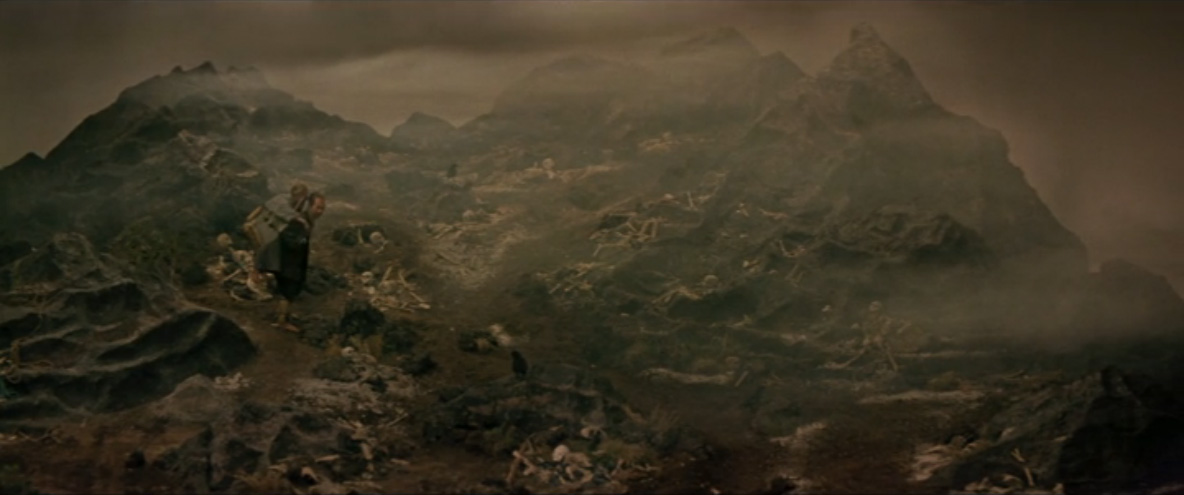
And in the end, Orin’s wish to follow tradition is honored by her son, who carries her into the mountains on his back. Following established ritual, they are not allowed to speak once they enter the Narayama area, and so Tatsuhei stumbles unwillingly, silently through forest and rock and then piles and piles of skeletons as crows look on.

The sets in the film are fascinating; obviously the backgrounds are paintings, and transitions are done by cutting the lights and moving large props to reveal new scenes such that it feels like watching a play. But the sets are sprawling and elaborate, larger than any theater could contain. The camera pans along them, following actors as they move down paths and into detailed structures. The Narayama skeleton set is eerie; I honestly didn’t expect it, and I stared speechless at the clusters of bones surrounding Orin and Tatsuhei.

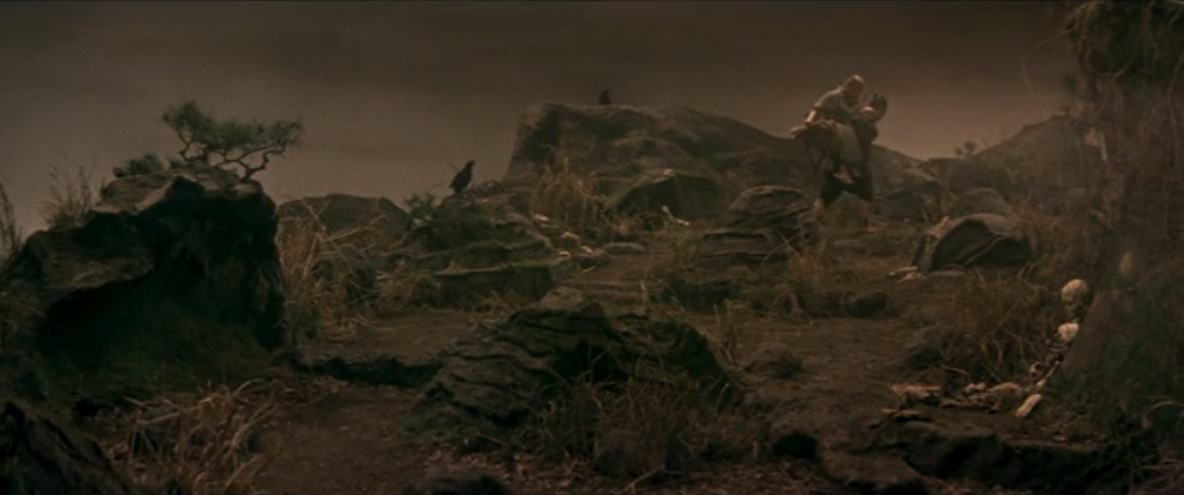
boneyard entrance

Tatsuhei and Orin in the boneyard

The final scene, showing a train pulling out of a station called Obasute, looked too real by comparison to all the other sets; it was jarring. I’m not sure what the point of that scene was, other than perhaps to make the point of the movie obvious. In my opinion it already was, so the scene is unnecessary.

I’m unclear on whether or not ubasute ever actually occurred. From the movie, I can understand why it might have–food supplies being low could inspire communities to dispose of their least productive members. Indeed, the film includes a different example of such a thing happening; an entire family is killed after it’s discovered they have been stealing. In this sense, I find the contrast between Orin and Kesakichi fascinating; of the two of them, Orin is far more useful to the family. (Orin knows how to catch trout, and shares her secret only with Tama; she admonishes the other woman not to tell anyone, perhaps highlighting the need for someone in this community to be of use. If only Tama knows the secret, her value goes up.)

What value does Kesakichi bring? He adds a mouth, eventually two mouths, to feed and doesn’t do his share of the work. If there was a “just” system for rooting out those who didn’t contribute, Kesakichi would be the first one kicked to the curb. But of course, getting rid of the young isn’t the tradition.

And despite the way he treats her, Orin loves Kesakichi and takes care of him and his girlfriend just as well as she takes care of the rest of the family. She is willing to sacrifice herself for the sake of tradition, but I wonder how she’d feel about others? After all, while she chides Mata for not going to Narayama, she still feeds him. Somehow, I can’t see her doing to Kesakichi what Kesakichi did to her.

Then again, even if she did, Kesakichi wouldn’t care. He’s not interested in tradition or saving face; he’s just interested in himself.

I’m sure this contrast between Orin and Kesakichi was intentional, meant to underline the importance of valuing our elders instead of tossing them aside. And I have to say it was effective, because I love Orin and I hate Kesakichi.

I found myself relating to and sympathizing with Orin. Her need to be accepted, to fit the mold others had created for her, was tragic, and cost her her life while she was still perfectly healthy. But she took it all with a smile, with no complaints. This made the message of the film far stronger than had she rebelled against her fate. We saw the lengths she was willing to go to stay in people’s favor; we understood the sheer ridiculousness of it; yet we knew she really had no choice, and that made her devotion to her reputation come off as brave rather than pathetic.

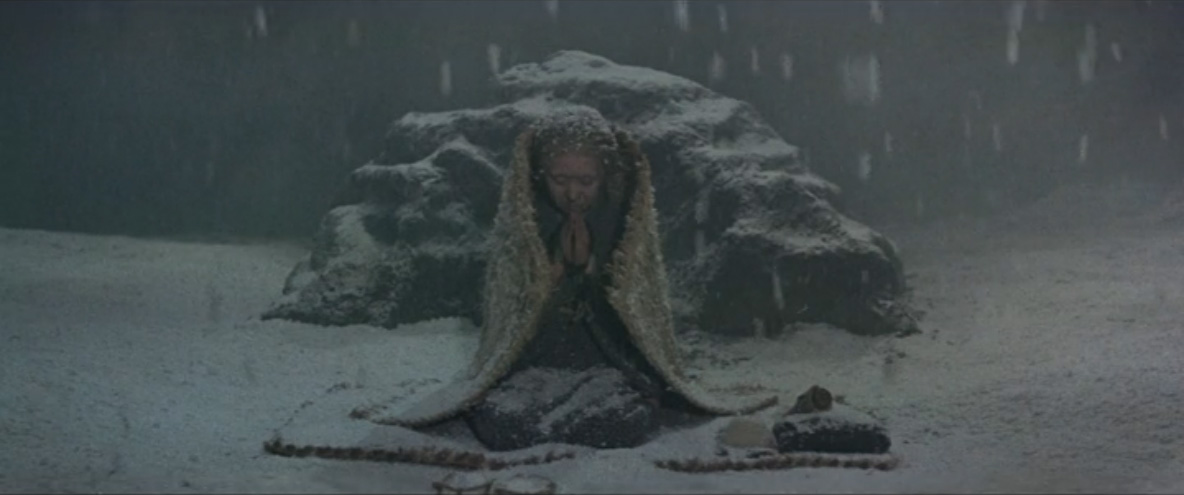
Orin in the snow

Orin waits in the snow to die. The Ballad of Narayama, 1958

Music used in Person of Interest

Sean and I love Person of Interest, a show whose heroes are like a combination of Batman and James Bond. Former CIA operative John Reese has the spy skills and general badassery; partner Howard Finch brings the technological expertise. Unfortunately the show isn’t available to watch online, so we don’t see it as it airs; instead, we wait for the season to end and buy the Blu-Rays. Season one is available here.

Aside from its excellent score, written by Ramin Djawadi of Game of Thrones fame, the show is augmented by some iconic tracks, listed on the Person of Interest Wiki. Here’s a guide to buying the tracks from season one on Amazon MP3, mostly for my reference but also for yours if you’re interested. The songs are sorted by artist.

We have the technology

I often feel that there are so many things we could be doing. So many things we are capable of. So many things we just aren’t achieving that we should be readily able to.

Sometimes I discover that we are at least partially doing those things, but we’re not doing them in a way that people know about or can find or share easily.

This morning I heard a tornado siren. It’s only the second time I’ve heard it since I’ve lived here. The first time, nothing happened, so this time, I didn’t think much of it. An hour or so later I saw a tweet remarking on Atlanta’s “tornado-y” weather, so I thought I’d see what the deal was.

I went to my go-to weather site, The Weather Channel’s weather.com, and clicked on my local forecast, which is saved in a tile at the top of the page. Then I clicked on the Alerts, and in the drop-down I saw Tornado Watch until 4pm. That was all I needed to know, so I left the page.

Some time later, I saw this tweet:

If you follow that image link, you get…a cell phone picture of a TV screen.

A cell phone picture. Of a TV screen.

I understand wanting to share important information quickly. Actually, I think the ability to do that is rather important. But it astonished me that the most efficient way to rapidly share vital information online was apparently to post a picture of it.

We have the data. We have the technology. We can do better.

I went poking around weather.com to find the source of that image–better yet, something that would stay up-to-date no matter when someone got the link. First I went to the Atlanta forecast page. I clicked on things, but never saw a map like the TV picture. I did find a list of affected counties, which is useful, especially for people who can’t see pictures. But I wanted to duplicate the experience a viewer of the picture would have–duplicate and enhance it.

Finally I clicked on the Map link in the sidebar, and that took me to the interactive Weather Map. This was the same thing I’d seen on the forecast page and ignored because it didn’t have the tornado warning areas highlighted. But I gave it a chance; I clicked on Map Options. Scrolling all the way to the very bottom, I finally found the Weather Alert Overlays, and I clicked the radio button next to Severe Alerts.

And there, at last, it was.

Weather Map screencap 01/30/2013I quickly sent a link and instructions in response to the tweet. Then it occurred to me to check the link on my phone. I opened Tweetbot and tapped the link and sure enough…the interactive map doesn’t work in iOS, because it uses Flash.

Sigh.

Here’s what I want. I want a map that works regardless of the device I’m using. I want the ability to share a direct link to the view I am using–in this case, Severe Alerts–not just a generic link to the default map (which is what you currently get from those sidebar social media buttons). I want a forecast page that calls up versions of the map that are relevant to any weather alerts currently in effect.

As I said, we are capable of so many things. So many useful things. So many things that would be a genuine help to society.

The thing is, if we try to do those things, we can’t just throw something together and say we’re done. We have to make it easy.

Otherwise, people will skip right past it and keep taking pictures of their TVs.

A breath of fresh air

I spent this past week in Kentucky with my family, and while there I didn’t check ADN, Twitter, or Google Plus at all. I got on Facebook about three times total, to check private messages and make sure no one had posted anything important to my timeline. The day after the election I tried Facebook again, but a quick scan through the news feed made me wonder why I ever used Facebook to begin with.

I realize a lot of this is just election exhaustion, and that will pass. But I truly enjoyed spending a week not checking social media obsessively. I left my phone in my purse most of the time and didn’t use it for anything but one phone call and maybe three text messages. (I may have also played a turn in chess, but I don’t remember.) I also didn’t unpack my computer right away, and when I did I mostly used it to review Japanese on WaniKani and to watch lectures and do assignments for my Coursera Python class. I also added to my Goals document, which I started working on in October. It’s a simple list of ideas I’ve had that I want to see to fruition.

The rest of my time was spent with family members, talking or playing games or enjoying meals. I got to celebrate Halloween, Connor’s 13th birthday, an early Thanksgiving, and Daphne’s second birthday. I didn’t really go anywhere beyond my parents’ house and my brothers’ houses, but it was relaxing, and I didn’t get too stir-crazy. (When I started feeling antsy, AJ took me to a cool walking trail so I could enjoy the fall leaves. It totally rejuvenated me.)

While I was staying with my parents, I also wrote a few entries in a journal, by hand. It takes a lot longer for me to write by hand than it does for me to type. I found that I was doing more crafting so I wouldn’t write anything poorly. I also found that I had no desire to share the brief brags, complaints, and jokes that I normally would post to social media without hesitation.

I used to despair that all my thoughts were lost to the ether. When social media came around, I thought it was my salvation. Finally there was a way to chronicle everything that went through my head. This was important to me, for some reason. I’ve always wanted other people to understand me, but I’ve rarely felt like anyone does. I suppose I thought the more I shared, the more others would learn about me, and maybe eventually they would come to understand me. (This might be a large reason why I have such a problem with lying or with being misrepresented.)

I’ve gone overboard with sharing here on the blog, and I think my social media participation is probably even worse. It’s so much easier. Just taking a week off from it, I feel very different…like I have so much more time.

I’m not sure yet what I’m going to do. As a professional in the web world, I probably need to maintain a social media presence of some sort. And it would help to stay on the cutting edge with things like ADN. But of all the social media I abstained from this week, the only one I really worry about quitting completely is Facebook, due as I’ve said before to the possibility of losing touch with far-flung friends and family. Maybe I will find a way to limit my participation, perhaps by scheduling a time each week or so to “catch up”. Or maybe I’ll do something else. For right now, I’m putting that decision off, as I don’t really have any desire to get back on social media.

Digital publishing idea from 2008

I was going through my old project ideas folder and came across this gem from November of 2008:

A means to publish works for reading on screens and handhelds–different resolutions that are all legible without zooming and possibly without scrolling.  Each “page” is now a “screen”.

No need for a separate device for reading.

Should be able to create with existing tools.  Perhaps pdfs that are then imported into a locked system of some sort.  Or something even more interactive.

Will work for newspapers and magazines.  No need for print versions!

Users would purchase the browsing software and then purchase each “issue” they wanted to read, or subscribe.  Their accounts would always be available to them online, with every issue they had access to.  They can also download each issue to any device on which they’ve registered the software.

Using technology to make in-house style guides more efficient

Companies that put out lots of content, have lots of employees, and want consistency in voice across their messaging will often have a style guide, which is good. If technology is leveraged, this can be even better.

Let’s say a company wants certain text in uppercase and certain text in title case. Often the copywriters are expected to type in the content in the required style. To me, this is the same as hard-coding boldness or color. Like other text transformations, case can be controlled by CSS. Companies could therefore simplify by having copywriters write all headlines and titles in title case. The content management system would label each item (via class or id) with a category, such as headline, subhead, etc., and the case of each could then be controlled via CSS. Not only would this simplify things for copywriters, cutting down on user error, but it would also make it simple to shift copy to a new format if there was ever a change to the style guide.

There are caveats. CSS is not natively able to transform text properly from uppercase to title case or sentence case, nor is it able to transform text from uppercase or sentence case to title case. Title case has strange rules–certain words are capitalized, others aren’t–that would have to be scripted. And transforming to sentence case presents another problem: there would be no way to preserve or create capitalization of proper nouns. If an organization knew all the proper nouns that were to be used in copy, this could be scripted as well, but it’s extremely likely that something would be missed, making this an imperfect solution.

I would handle all these situations by simply having copywriters write everything in sentence case. Transformations to title case could be achieved through scripting, as there are finite rules as to what gets capitalized. The capitalization of proper nouns would also be preserved. Meanwhile, changing to uppercase would be a simple CSS transformation.

This discussion has been web-focused, but I imagine something similar could be done for print.

Speaking of print, it amazes me that some organizations keep their print and online content storage separate. I would put them all together in a robust, customized CMS. Yes, the two have different needs, and those would have to be dealt with. But there is also a lot of crossover. Having everything in the same place would ensure consistency across the organization’s media.

Sherlock deductions

Sean and I finally watched series two of Sherlock, finishing up last night, and I’m so excited about my Reichenbach deductions that I wanted to write them out. If you haven’t seen series two, stop reading now and go watch it on Netflix. Then come back.

Here are the things we know:

Sherlock chose the final meeting place with Moriarty.

Sherlock doesn’t fulfill Moriarty’s demand until John arrives. He tells John exactly where to stand and watch, and he also tells him some very specific things, saying it’s important.

When Sherlock jumps, he doesn’t go head-first. As smart as he is, he’d know that would be the best way to die. Instead, he jumps in such a way that he’d seemingly land on his hands and knees.

After the fall, the first thing that happens is John is clipped by someone on a bike. He’s disoriented. By the time he’s back on his feet, a crowd has clustered around the “body”. John runs over, but time has passed. And the crowd, while letting him get a look, ultimately doesn’t let him examine Sherlock.

We don’t see the funeral. We therefore don’t see if it was open casket.

We don’t see what happened to Moriarty. No one but Sherlock knew he’d “shot himself”.

More generally:

Sherlock Holmes, like James Moriarty, is an actor. He can pretend anything. He can even be friendly if he wants to; he just rarely wants to.

Sherlock and Moriarty have similar intellects and drive. They are both willing to go beyond what would normally be considered, well, sane. We know this from the end of series one, not just from the conversation and suicide one-upsmanship at the end of series two.

The information Moriarty has on Sherlock comes primarily from their interactions in series one and from Mycroft. This means he is estranged from new information, especially after Sherlock finds the hidden camera.

As Sherlock has never indicated any interest in Molly beyond using her as a tool, Moriarty has no reason to think she is important to him. Indeed, Sherlock confirms this when he asks, “Watson? Mrs. Hudson? Lestrade?” (Technically Molly may never have caught Sherlock’s notice if she hadn’t observed his mental state, but that’s tangential. The point is, up until then Sherlock never would have considered Molly a part of his “team”, and so Moriarty doesn’t either.)

I believe that at the point Sherlock told Molly he thought he was going to die, he had already deduced 1) how Moriarty had managed his break-ins; 2) how Moriarty planned for his taking-down of Sherlock to end–suicide in disgrace. He may have even deduced 3) how far Moriarty was willing to go to ensure Sherlock killed himself. And as he knew Moriarty would have plans in place to deal with Watson, Mrs. Hudson, and Lestrade, this knowledge didn’t help him come up with a way to outfox Moriarty, because if he enlisted their aid, Moriarty would know…hence Sherlock’s desperation, and his sudden epiphany that he could rely on Molly.

(I imagine the writers are making a point about the importance of human relationships here, a theme I think the Holmes-inspired House could have used a bit more of…but perhaps I’m reading in a bit too much ;)

And so Sherlock’s plan to save his friends and best Moriarty depended on two things: Moriarty not knowing he was relying on Molly, and Moriarty continuing to underestimate him. Sherlock had to act out his deductions as if he were having them for the first time on the rooftop, too late to do anything about them. But in reality, he’d already set a plan in motion through Molly that would allow him to jump from the rooftop, appear dead, but emerge unscathed. This plan had the crowd below, the guy on the bike, and even the medical team that picked up his body in on it–just as Moriarty had people at every level in on his break-in scheme.

Further, I don’t think Moriarty is really dead; he goes on and on about how hard it is to keep on living when everyone is so dull, but the sense of self-preservation isn’t that easy to kick if you’re not actually depressed…and Moriarty isn’t depressed. He’s bored. “Killing” himself probably seemed like a fun idea. Sherlock probably knew Moriarty wasn’t dead, as well, but he’d tried the verbal jousting route and the safest way to protect his friends was to go through with the fake suicide plan.

What I’m interested in seeing is where things go from here. I don’t quite remember from the stories, but I believe there was one in which Sherlock was said to have survived Reichenbach Falls after all. Maybe in the interminable time before series three I’ll go back and reread.

Social media quandary

Some time ago, I reached a point of crisis with Facebook. I was (and am) terribly unhappy with the company’s lack of respect for its users. Facebook users are not the customer; they’re the product. Mark Zuckerberg has little respect for privacy and seems only interested in pleasing advertisers. While I realize Facebook needs to make money, I don’t think that should happen at the cost of people’s feeling of personal security.

However, despite that huge issue, I continue to use Facebook, because that’s where everyone is. Or, more specifically, that’s where a majority of my far-flung real life friends are. Facebook makes it simple for me to keep up with people I otherwise wouldn’t hear from for months, years, or at all. I have always been terrible with keeping up with people myself, so this has been a godsend. And through Facebook I have developed deeper friendships with people who were once simple acquaintances. I’ve planned travel. I’ve shared and received affirmations and support. Facebook is where I go for community. It’s not a paradigm that can be replicated.

Twitter, I’ve come to discover over the past few days of trying very hard not to use it, is also an non-replicable paradigm.

I never thought I would have to try and find an experience to replace what I have on Twitter. Unlike Facebook, where I reveal information only behind tiered walls of (questionable) privacy, my tweets have always been public. Anyone is welcome to them. I have very few real followers, but I have over the years since I joined in February of 2007 curated a following list of interesting, funny people and accounts, one that enriches my life with daily musings, links to important news articles, beautiful photos, and more. I’ve also enjoyed sharing my own thoughts and occasionally receiving feedback.

As Twitter works toward profitability, things keep changing. I had always believed Twitter was more interested in its users than Facebook was, that Twitter would ultimately have its users’ backs. But one thing always bothered me: Why, if Twitter still has all my tweets as it claims, won’t it let me have them?

Unhappy that my tweets were seemingly going into a void from which they could never be recovered, I recently set up a rule with If This Then That that saves any tweet I post into a text file on Dropbox. Doing that, I was confident that at least going forward I would have access to my own content.

But then Twitter changed its API terms for developers, directly affecting my solution. IFTTT sent me an email about it, directing me to the Developer Rules of the Road and specifically this paragraph under “Twitter Content”:

You may export or extract non-programmatic, GUI-driven Twitter Content as a PDF or spreadsheet by using “save as” or similar functionality. Exporting Twitter Content to a datastore as a service or other cloud based service, however, is not permitted.

This rather creepily makes it sound like my content, the stuff I write, belongs to Twitter, not me. And as the content belongs to Twitter, I apparently have no right to use a process to save it. I would have to manually copy and paste from the GUI, if I’m reading this correctly. They know no one’s going to actually do that.

I realize this section exists to stop people from cross-posting their tweets to other services (which also seems draconian, no matter how annoying I find cross-posted content), but it effectively locks me out of my own writing, again. Let’s say I instead decide to post on some other service that allows me full access to my content, and then cross-post to Twitter. I could save the original posts I write that way, but not replies. I also wouldn’t be able to save retweets, which, while secondary, provide context to what I’m writing and insight into what I was thinking about while writing.

When I read the email from IFTTT on Thursday, I tweeted a little about it with shock and dismay, and then stopped tweeting altogether. It’s been about three days…but it feels more like a month.

In the meantime, I did what I could to get the content I enjoy on Twitter elsewhere. I went over to Google+ and added everyone I could find. I even pulled in news organizations I’m interested in and removed them from Facebook–but it looks like most of them post more to Facebook than Google+. Similarly, most of the people I followed on Google+ don’t post there much. The bulk of content is back on Twitter.

I’ve also been using App.net Alpha and the iOS app Spoonbill to participate in the new App.net-powered community that I’ll just refer to as ADN for simplicity’s sake. (App.net has the capability to support multiple communities, though I’m not sure that’s been done yet.) While that community is interesting, it’s sort of weird. (One conversation I witnessed, Person A: “Don’t you have a personal lawyer?” Person B: “Of course; I have several.”) There are a few people who, like me, talk about their lives, but for the most part I see people talking about tech trends, social media theory, marketing, and occasionally politics. It’s good content, but it’s not everything I want. Not by a long shot. There’s no @Lileks there. Little to nothing about journalism, photography, design, language, culture, or travel. @Horse_ebooks is there, but I hate @Horse_ebooks. The people I actually know who have signed up haven’t posted much of anything. It feels like a large number of the active people on ADN live in the Bay Area, adding to the sort of tech elitist ambiance. I have had very few conversations there.

So no, ADN can’t replace Twitter for me, at least not now. There isn’t enough adoption, I suppose. I even sort of feel weird posting there, like I’m spamming up a special place with my worthless thoughts. Rather the opposite of how I assumed I would feel about using a paid service that puts the users first.

ADN can’t do it, Google+ can’t do it, and I refuse to change the way I use Facebook (especially since that would give Facebook more data about me). So it would appear that I have no choice but to use Twitter, at least in terms of reading.

I’ve heard rumors that Twitter will start allowing users to download their tweets by the end of the year. But rumors like that have existed for awhile. I’ll believe it when I see it.

For now, I’ll probably keep reading Twitter. But I’m not sure I’ll be actually posting much there.

The future of content, Part 4

I’ve talked about redesigning the web into a collection of interconnected pieces of content, and I’ve discussed monetizing such a paradigm. Now I’d like to go further into the value this reconstruction would bring to content creators, sharers, and users.

The way the web works right now, content creators and sharers typically must either have their own website or use third-party services in order to build an audience and make money. Under this paradigm, the websites (or their content streams) are the main point of interest, and the onus is on the site owners and managers to “keep the content fresh”. In the case of businesses, this includes finding and hiring/contracting creators and negotiating licensing agreements with third-party content providers. The now-now-now pace puts pressure on creators to write something, anything, in order to keep people coming back to the site. This has resulted in a glut of content that is posted for the sake of having new content posted. SEO marketing has exacerbated the issue with content posted for the sake of higher search engine rankings. People are wasting more and more time reading navel-gazing content that adds little value to the human community.

With a web that is truly content-driven, the focus would shift from trying to keep thousands of disparate sites and streams “fresh” to trying to produce and share content that is meaningful, impactful, and important. With IP issues handled through robust tagging, content would be available for anyone to share. Licensing would be streamlined, and creators would be directly paid for their work. Media houses could more confidently keep creators on staff; sharing would provide an obvious metric of a creator’s value. Creators could focus on more long-form pieces, knowing that their existing work would continue to be shared and monetized. There would be less pressure to post something, anything, every day.

The web has suffered from the adoption of the “always on” mindset. If there is nothing new to report, there is no need to invent something to report. Someone, somewhere, is always producing content; it’s a big world. Rather than polluting millions of streams with junk, media companies, news organizations, marketers, and individuals should shift their focus to finding and sharing value. Simply aggregating RSS feeds or repurposing content the way we’ve been doing it so far is not enough; it does not meet the needs of the user and it does not ensure that content creators are paid for their work. We need to rebuild the system from the ground up.